



Authors: Jen Lerch, Marijana Kotlaja, Rebecca Stone, Dr. Tameka Williams
Motherhood is often invoked in the criminal legal system as a moral standard.
Be a better example.
Think about your children.
You should have known better.
But rarely is motherhood treated as a reality the system must respond to for individuals who must navigate it following arrest. Rarely is it meaningfully considered in decisions about arrest, detention, jail release, or sentencing. Instead, it becomes something else entirely: a measuring stick for blame.
And in that shift, something profound happens. The system doesn’t just process cases. It quietly reorganizes families.
We often say the system isn’t set up for mothers. But the truth is more uncomfortable than that. The system is set up in ways that treat parenting as a liability, something that complicates compliance rather than something worth preserving.
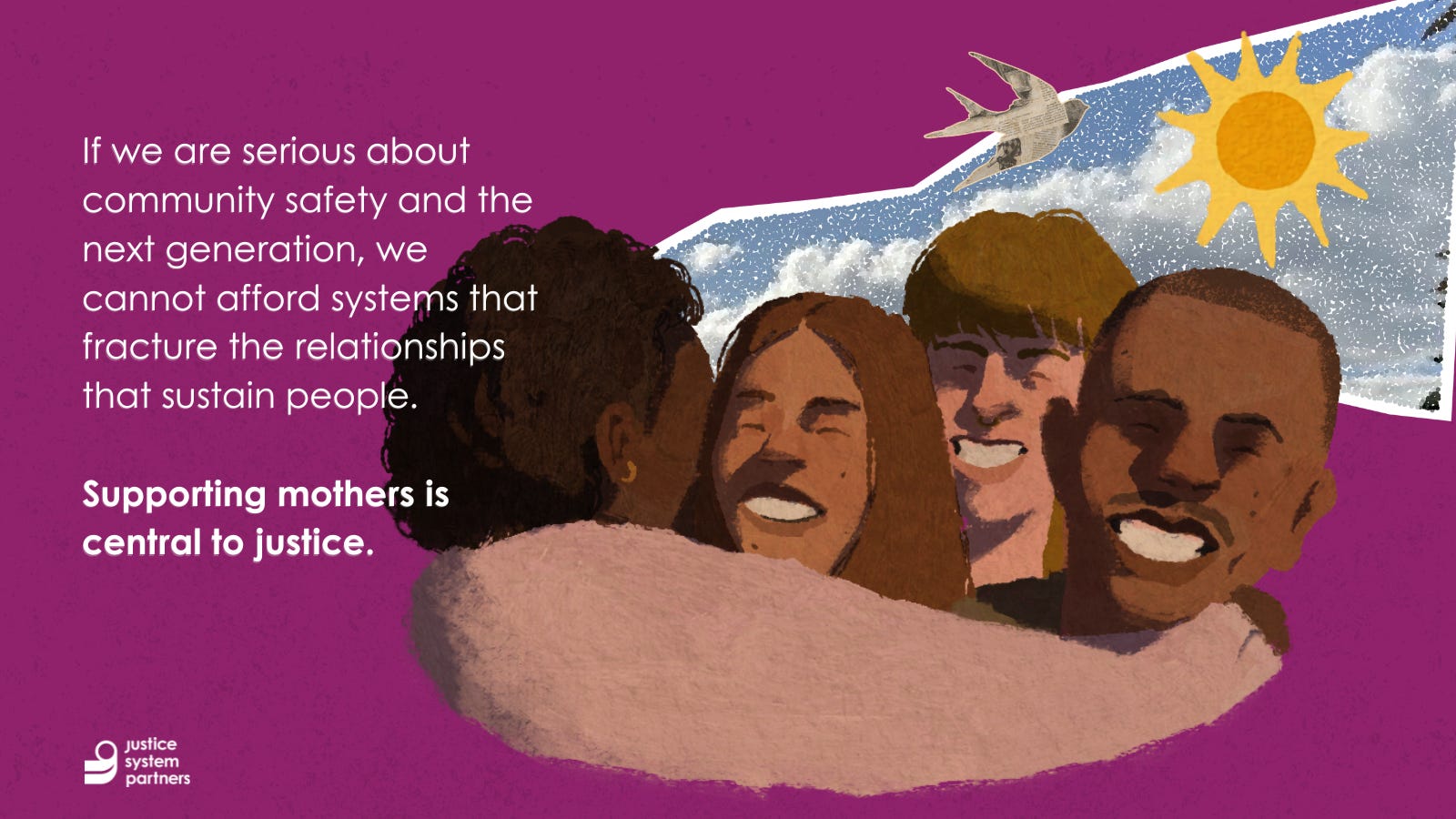
If we are serious about public safety, and about the stability of the next generation, we cannot afford to perpetuate systems that fracture the very relationships that sustain people. Supporting mothers is not a side issue. It is central to what justice should mean.
The moment of arrest: motherhood as an afterthought
The system’s relationship to motherhood often begins with absence.
At the point of arrest, there is rarely a structured way to account for caregiving responsibilities. A mother can be taken into custody without a plan for who will pick up her child from school, who will prepare dinner, or who will explain why she didn’t come home. Children are left in the gaps of procedure.
There are no universal protocols requiring officers to identify whether someone is a primary caregiver or to ensure their children are safely connected to another adult. Research and advocacy have documented what follows: children left in uncertain situations in the hours after a parent’s arrest often bear the weight of the disruption without explanation.
We could build systems that ask, automatically: Is there a child who depends on you? Where are they right now? Who can step in? Some jurisdictions have begun piloting policies like this, but they remain the exception, not the rule.
Instead, motherhood is treated as peripheral to “the case,” even though it is central to everything that follows.
Pretrial Detention and Release: The impossible balance
In courtrooms, motherhood is everywhere—and nowhere. It surfaces in language: you should have thought about your kids, you’re supposed to be a role model, but rarely in design. Decisions about pretrial detention, or pretrial release and supervision conditions are made every day with little structured consideration of caregiving responsibilities, even though research consistently shows that most women in the system are mothers, many of them primary caregivers.
Instead of shaping how the system responds, motherhood becomes a moral overlay and a way to assign greater blame. The question is not what does this family need to stay intact during case processing? but how could you do this as a mother? And in that shift, the system stops responding to motherhood and starts punishing it.
Nowhere are these contradictions more visible than in pretrial. If a mother is detained, even briefly, the consequences can cascade quickly: loss of employment, housing instability, and disruptions to custody arrangements. Even a few days in detention can increase the likelihood of future system involvement while heightening the risk of child welfare intervention, sometimes leading to prolonged or permanent separation.
If she is released, the instability doesn’t disappear. Instead, it shifts form. Pretrial conditions often assume access to flexible work, reliable childcare, and consistent transportation, resources many mothers do not have. So, they navigate impossible tradeoffs: attend court or risk losing a job, care for a sick child or risk a violation, pay for transportation or pay for groceries.
Court dates, check-ins, and court requirements are layered onto already fragile routines, demanding a level of flexibility that caregiving does not allow. When those expectations collide with reality, the system reads the outcome as noncompliance. But what it is really measuring is the absence of support for mothers.
Motherhood doesn’t excuse accountability during the pretrial period but it should fundamentally shape how we define it. That means starting from a different premise: when it is safe to do so, mothers should experience pretrial release as a default. It means setting conditions of pretrial release that mothers can realistically meet, and recognizing that caregiving responsibilities, will, at times, require flexibility.
Missing pretrial appointments because a child is sick or childcare falls through should not trigger a return to jail—especially for someone who is legally presumed innocent. We should not define accountability in the pretrial context by compliance alone, but by whether people ultimately appear in court. When people, including mothers, miss court, the response should be support and re-engagement, not more punishment.
This is not a “soft on crime” approach. It is an evidence-informed one, grounded in what we know about what keeps families intact, reduces continued system involvement, and supports public safety.
Incarceration: The Cost of Separation
In prison, motherhood becomes structured absence.
Facilities are often located far from home, making visits difficult or impossible. Phone calls are costly. Communication is limited. The financial and logistical burden of maintaining connection falls on families already under strain, requiring time, money, and coordination that are not evenly distributed. For many mothers, staying connected to their children becomes not just an emotional effort, but a practical challenge shaped by distance and resources.
This separation carries distinct consequences. Unlike fathers, incarcerated mothers are far less likely to have their children remain in the same home. Instead, children are more likely to move between caregivers, enter foster care, or experience prolonged instability. And the scale of impact is significant: more than five million children in the United States have experienced the incarceration of a parent, with research consistently linking that experience to increased risks of depression and anxiety, lower educational attainment, and a greater likelihood of future system involvement.
For some women, this experience begins even earlier during pregnancy and childbirth. As scholars like Angela Hattery and Earl Smith document in Policing Black Bodies, incarceration extends state control into the most intimate aspects of motherhood. Pregnant people may receive inconsistent prenatal care, face restraints during transport or labor in some jurisdictions, and give birth under conditions that prioritize security over dignity. In most cases, they are separated from their newborns within hours or days of delivery.
Motherhood, in these moments, is not just interrupted, it is constrained, monitored, and, in many cases, denied.
Programs attempt to bridge this distance. Some allow mothers to record themselves reading books to their children. Others offer parenting classes or limited opportunities for connection. Initiatives like Storybook Project create meaningful moments of contact, preserving voice and presence in small but important ways. These programs matter but they are not a substitute for presence.
The broader system treats separation as an unavoidable byproduct of punishment. But for mothers and their children, separation is not secondary. It is the experience itself. Distance during incarceration reshapes families long after release—altering individuals’ motherhood identity, attachment and reunification, and stability for the family unit overtime.
Separation, in this context, is not neutral. It is disruptive, destabilizing, and deeply consequential not only for mothers, but for the children and communities who carry its impact forward.
Probation: Supervision without Support
Probation is often framed as the alternative to incarceration, a way to remain in the community, maintain stability, and move forward. But for many mothers, it functions less as an off-ramp and more as a system of strain: appointments are scheduled during work hours. Offices are rarely designed for children. Transportation is inconsistent. Childcare is expensive or unavailable. And yet, compliance assumes all these things are in place.
So, mothers improvise. They bring their children to appointments and hope it’s allowed. They reschedule and risk being labeled noncompliant. They choose between paying for groceries for the family or paying their court fines and fees, between caring for a sick child and meeting a check-in with their probation officer. What appears, on paper, as a simple expectation often collides with the realities of caregiving in ways the system does not allow.
Research makes clear how these moments accumulate. Technical violations (breaking probation rules), not new criminal behavior, drive a significant share of probation revocations and returns to incarceration, in some jurisdictions accounting for the majority. And many of those violations stem from missed appointments or unmet conditions that, for mothers, are directly tied to caregiving responsibilities: a child who needs to be picked up from school, the absence of childcare, a bus that doesn’t arrive on time. These are not exceptional circumstances but everyday life.
Yet the system rarely accounts for this context.
What could be a missed appointment becomes a violation.
A violation becomes a case on the probation revocation docket.
That revocation can lead to returning to incarceration.
This is how systems designed to keep people in the community end up pulling them back to jail. Layered onto this is a persistent narrative that mothers involved in the system are not only responsible for their own actions, but for what their children might become. The expectation is not just compliance, but moral redemption, performed under conditions that make stability difficult to achieve.
This is the motherhood penalty. It is not just that the system fails to support mothers. It is that it measures their success without accounting for what they are carrying and then judges them for falling short.
Pathways into the System: When Motherhood is Policed
For many women, involvement in the system is not separate from motherhood it is shaped by it from the very beginning. Some enter through complex domestic violence situations, where actions taken in the context of survival are misread and prosecuted as criminal behavior. Others are drawn in during pregnancy or through decisions related to reproductive health. Still others experience ongoing surveillance through child welfare systems, where poverty, housing instability, and structural inequities are reframed as neglect.
These are not isolated pathways. They are interconnected systems that shape how motherhood is defined, monitored, and judged. Research and scholarship, particularly from Dorothy Roberts, have long documented how these systems operate in tandem, disproportionately surveilling and separating Black mothers from their children. In Torn Apart, Roberts describes how the child welfare system often functions less as a source of support and more as a mechanism of family regulation, deeply entangled with the criminal legal system. Similarly, in Policing the Womb, Michele Goodwin traces how pregnancy itself has become a site of legal intervention, with some states pursuing criminal charges related to substance use during pregnancy.
The result is a system in which motherhood is not just a responsibility, but a point of entry into the criminal legal system, a point of surveillance, and, too often, a point of punishment.
And it is not evenly distributed. Black and Brown women are far more likely to experience these overlapping forms of intervention, reflecting a long history of scrutiny, control, and regulation of their parenting. What might be understood as need in one context is reframed as risk in another.
In this way, the criminal legal system does not simply respond to harm. It defines it through a lens that turns perceived deviations from an idealized version of motherhood into evidence of it.
What Would it Look Like to Take Motherhood Seriously?
There are glimpses of what a different approach could look like. In policing context, there is a growing national model for keeping children safe during parent arrest. In some courts, there is growing recognition that pretrial decisions and supervision conditions should account for the realities of caregiving. Others have begun offering on-site childcare, recognizing that access is a prerequisite for participation, not a side concern. Programs that support connection between incarcerated parents and their children, like the Storybook project, demonstrate how even small investments in maintaining relationships can reduce harm and support long-term stability.
But these efforts remain isolated, operating at the margins of a system still largely designed without families in mind.
A more expansive approach would treat caregiving obligations as critical information at every decision point, not an afterthought. At arrest, it would trigger immediate planning and support to ensure children are safe and connected. In pretrial, release decisions would meaningfully account for family stability, and conditions would be designed around the realities of work, childcare, and transportation. In incarceration, proximity to home and sustained family connection would be prioritized, not treated as secondary to security. And in probation, systems would adapt to parents, not the other way around, with flexible scheduling, childcare access, and family-centered supports that make success possible.
This is not just a matter of compassion. It is a matter of community safety. Research consistently shows that stability reduces criminal legal system involvement, that maintaining family connections improves reentry outcomes, and that children do better when those relationships are preserved.
But beyond these structural adjustments, there is a deeper shift required. We must stop treating motherhood as a moral test and start treating it as a reality that systems must accommodate.
Because even after formal involvement ends, the effects remain. Children grow up with the memory of absence. Relationships require rebuilding. Economic instability lingers. Opportunities narrow over time. The criminal legal system does not simply intervene in a moment, but it reshapes the trajectory of families.
And when motherhood is ignored in the design of that system, its impact does not end with a case. It extends into childhood, into communities, and across generations.
Supporting Mothers is What Justice Requires
We often say the system isn’t set up for mothers. But the truth is more uncomfortable than that. The system is set up in ways that treat parenting as a liability, something that complicates compliance rather than something worth preserving.
If we are serious about community safety, and the stability of the next generation, we cannot afford to design and perpetuate systems that fracture the relationships that sustain people. Supporting mothers is not a side issue, it is central to what justice should mean.
And until we do, we will continue to measure accountability in ways that ignore what matters most and pass the cost of that failure from mothers to children, and from children to the next generation.
Authors’ Note
The mothers of Justice System Partners wrote this piece. Our perspectives are shaped not only by our work in the criminal legal system, but by our lived experiences including as a Black woman, as immigrants, as a mother of interracial children, and collectively as mothers raising the next generation in a system we know too well.
While we do not all share the same identities, we write not just as researchers or practitioners, but as people who understand—personally and professionally—how systems shape, scrutinize, and too often disrupt families like ours, and what is at stake when they fail to support mothers and the families who depend on them.